Stud Finder App vs Real Stud Finder: What Each Can and Cannot Tell You

Short answer: a stud finder app should not be treated as equivalent to a real stud finder or wall detector when you are deciding where to drill. A phone app may offer a convenient clue, depending on what the app and handset are actually measuring, but it is not a dedicated wall-scanning instrument. A real detector is built for wall checks, yet it still gives indications rather than certainty. Neither option proves that a chosen drill point is free from wires, pipes or other concealed objects.
For a first-time UK homeowner trying to put up shelves, blinds or a television bracket, the real question is rarely just where the stud is. It is what might be behind the surface, whether the wall can support the intended fixing, and what would make the sensible decision to stop. That wider question is why the cheapest or quickest option is not always the most useful one.
What a phone app is really competing with
The phrase stud finder app makes the comparison sound simple: free software versus a paid tool. In practice, it compares a general-purpose phone running an app with a dedicated detector category. A phone was not primarily designed to scan walls. Its result depends on the handset, the app, the surface, nearby interference and the assumptions built into the software. You should not assume that every phone contains the same sensors or that every app is measuring the same thing.
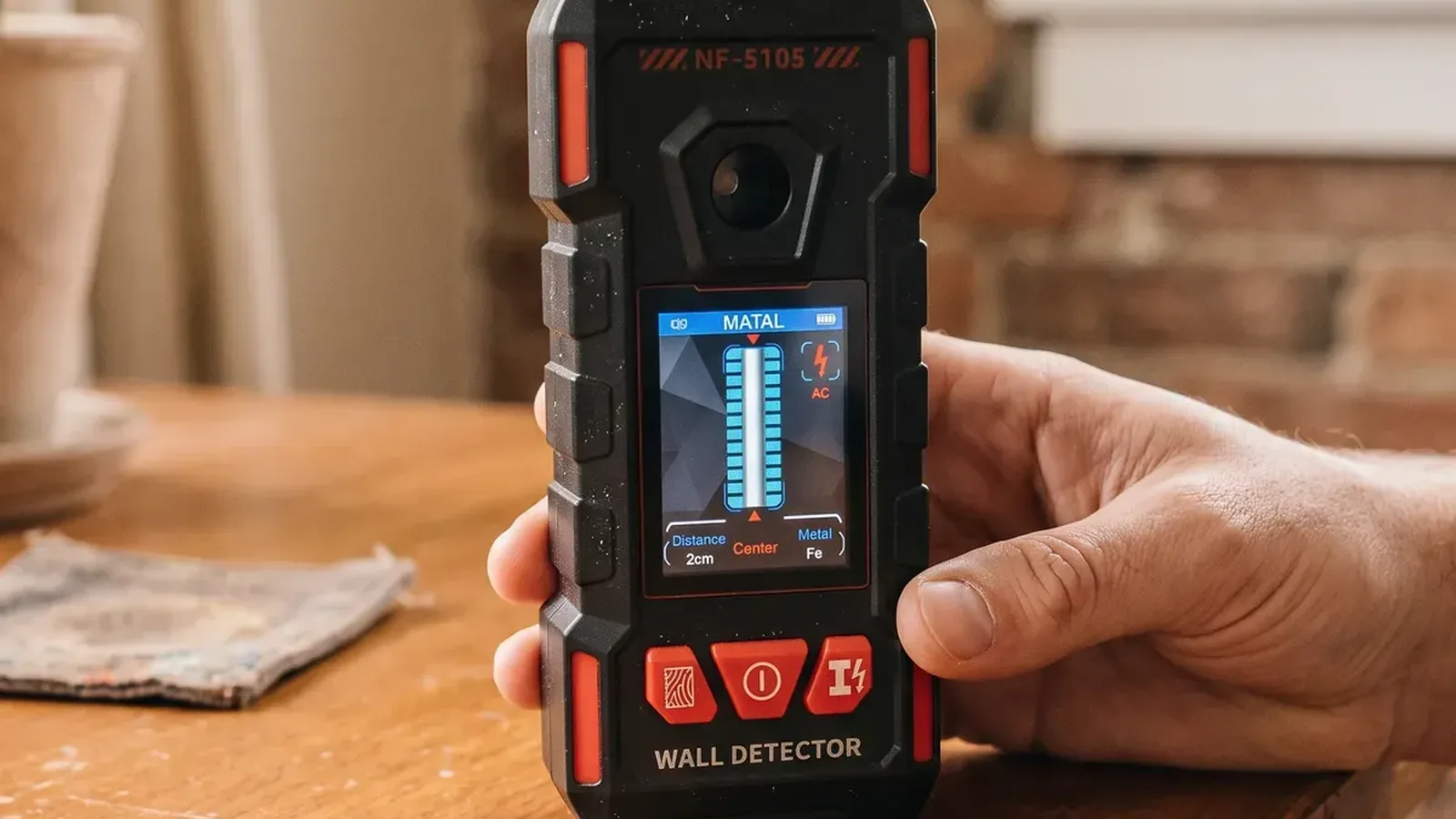
A dedicated stud finder or wall scanner is designed to be moved across a surface and to report a possible change or concealed object, depending on the model. That makes it the more relevant category for a serious pre-drilling check. Even so, the word finder can create too much confidence. A detector is not providing an X-ray image. It is interpreting signals within the limits of its design and the wall in front of it.
Why a real detector still does not mean certainty
Dedicated detectors may be designed to indicate materials such as metal, possible live wiring or wooden studs in dry walls. Manufacturer guidance for detector categories also shows why the result must remain provisional. Damp walls, metallic foil, conductive surfaces such as some tiles, earthing conditions and nearby electromagnetic interference can affect whether a possible cable is indicated clearly, shown over a broad area or not indicated as expected. Other objects may also be ambiguous.
A detector can therefore improve the information available before drilling, but it cannot certify a safe drill point. It does not prove that a conductor is dead. It does not assess the condition or capacity of a fixing point. It does not replace visible clues, plans, repeated checks or a competent tradesperson when electrical or structural uncertainty remains.
App versus detector: a practical comparison
| Question | Stud finder app | Dedicated stud finder or wall scanner | Pre-drilling meaning |
|---|---|---|---|
| What is it built for? | A software use case that varies by app and handset. | A dedicated wall-checking task. | The detector is the more relevant category for planned wall work. |
| Can it locate timber? | Do not assume this without evidence for the exact app and phone. | Some detectors are intended to indicate wooden studs in suitable dry walls. | Confirm the wall type and repeat the scan before interpreting a pattern. |
| Can it find hidden wiring? | Do not rely on an app to clear a wall for wiring risk. | Some scanners indicate possible live wiring, but wall conditions can limit the result. | A negative result is not proof that wiring is absent or safe. |
| Does it identify the object? | Usually not enough for a drill or no-drill decision. | May report a likely category, depending on the model. | Treat the output as a clue, not a final identity label. |
| Best role | Low-risk curiosity or a secondary clue. | Planned checks before shelves, rails, brackets or cabinets. | Choose according to the consequence of a wrong decision. |
When the phone-app route is too limited
Be especially cautious near sockets, switches, wall lights, kitchen services, bathroom fittings or any wall that has been altered by a previous owner. Electrical Safety First advises DIYers to locate wall cables before work, avoid drilling or screwing close to cables, switch off power for DIY close to electrics and seek advice from a registered competent electrician when unsure.
A small hole does not always mean a small risk. Hitting a cable or pipe can cause serious injury, damage and an urgent repair. If an app result is the only reason you feel comfortable drilling, you do not have enough information. Use a more suitable detector, move the proposed fixing, gather another source of evidence or bring in the appropriate trade.
A better pre-drilling workflow
Start by identifying the wall and the job. Plasterboard on timber or metal framing presents a different problem from solid masonry, tiled walls or an unknown layered construction. Then note visible service clues: sockets, switches, wall lights, radiators, boiler controls, pipe entries, extractor controls and previous fixing holes. These do not reveal every route, but they help you recognise when a proposed hole sits in a higher-risk area.
Scan a wider area than the bracket footprint rather than testing only the exact hole positions. Move the detector in the way its instructions specify, repeat passes from different directions and mark a zone rather than a single magic dot. If readings spread, disappear, move between passes or conflict with visible clues, stop and reassess. A no-drill decision is a useful outcome, not a failed scan.
Quick buying and use checklist
- Define the job: picture, shelf, mirror, blind, rail, cabinet or television bracket.
- Identify whether the wall is likely to be plasterboard, solid masonry, tiled, damp, foil-backed or altered.
- Do not assume that a phone app performs the same task as a dedicated detector.
- Look for nearby sockets, switches, lights and pipe entries before choosing a drill point.
- Choose a detector category that matches the objects and wall type you need to investigate.
- Repeat scans and mark uncertain areas rather than declaring one point safe.
- Read no signal as no signal detected, not as proof that nothing is present.
- Follow Electrical Safety First advice for DIY near electrics and remember that safe isolation is a separate competent-person practice.
- Move the fixing or seek professional help when the evidence does not agree.
How the choice changes with the job
For a lightweight picture on a simple wall, the consequences of a poor fixing may be limited, although concealed services still matter. For a shelf, curtain pole, blind or mirror, repeated fixings and greater load raise the cost of a wrong assumption. For a television bracket, kitchen cabinet or handrail, the decision is not merely about locating timber. It also involves wall construction, fixing instructions, hidden services and load.
If wiring is the main concern, use the site's guide to finding wires before drilling in the UK. If you are still choosing a detector category, the best stud finder UK guide provides broader buying context. Magnetic tools have a narrower role, explained in the magnetic stud finder UK buyers guide.
FAQ
Can I use a free stud finder app for one quick hole?
You can treat it as a clue if you understand exactly what it measures, but it should not be the basis for drilling where hidden wires, pipes or uncertain construction may be present. The consequence of being wrong matters more than the number of holes.
Is a real stud finder enough to avoid cables?
No. A wall scanner may indicate possible concealed objects, including possible live wiring on some models, but conditions can affect the result. It does not prove that a conductor is dead or that a drill point is safe.
Why do detector readings change between passes?
Wall build-up, moisture, metalwork, foil, conductive surfaces, earthing and nearby electronics can influence indications. Repeat the scan as instructed and stop if the pattern is not stable or plausible.
What if I only need to find timber studs?
First confirm that the wall is likely to contain timber framing. Some UK walls are solid masonry, dot-and-dab dry lining or metal-framed partitions. On the wrong wall type, a timber-stud interpretation may be irrelevant or misleading.
When should I call an electrician?
Use a registered competent electrician when you are unsure about electrical risk, when the planned drilling is close to wiring or electrical accessories, or when the work itself involves electrics. An app and a wall detector cannot perform safe isolation or electrical testing.
Final buying advice
Choose according to the risk of the job, not just the convenience of the tool. A phone app may provide a secondary clue, but it is not a substitute for a dedicated detector where concealed objects matter. A detector still has limits, so use it as one part of a cautious pre-drilling decision. As a next step, you can review a multi-mode wall detector and decide whether that tool category suits the wall checks you actually need.
Sources and further reading
- electricalsafetyfirst.org.uk: UK DIY guidance to locate concealed cables, switch off power near electrics, avoid drilling close to cables and seek a registered competent electrician when unsure.
- bosch-professional.com: Detector-category evidence for dedicated scanning workflows and limitations caused by damp walls, metallic foil, conductive surfaces, earthing, interference and object ambiguity.
- electricalsafetyfirst.org.uk: Safe isolation and proving conductors dead are separate competent-person electrical safety practices.
- hse.gov.uk: HSE guidance frames work on or near electrical equipment as requiring safe working practices and competence.