Can a Wall Scanner Scan Through Tiles? What Can Distort the Reading
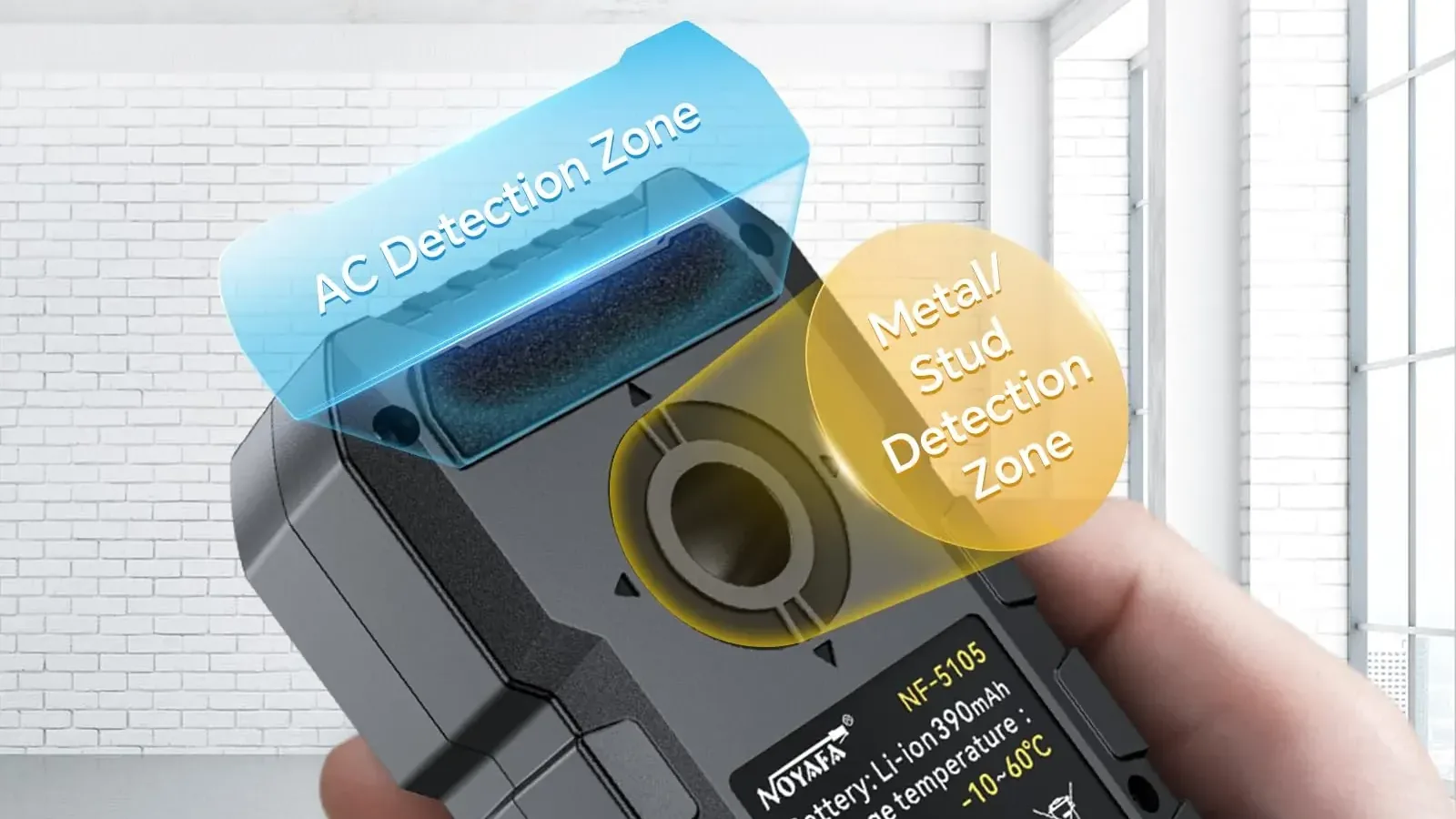
Short answer: a wall scanner may give an indication on a tiled surface, but you should never assume it can reliably scan through tiles. Tile, adhesive, backing board, moisture, metallic foil or mesh, conductive finishes and the wall behind can all affect the result. A reading is a clue, not proof that there is a safe drill point behind the tile.
The question often comes up before fitting a bathroom cabinet, shower screen, mirror, shelf or towel rail. Those jobs become more complicated when the surface may conceal water pipes, electrical cables, metal trims, waterproofing layers or old repairs. The finish is not merely decorative; it changes the material between the scanner and the object you want to understand.
Why tiles make scanning harder
A painted plasterboard wall and a tiled wall are different scan environments. A tiled wall is a layered system: tile, adhesive, grout, backing board or plaster, sometimes a waterproofing layer, and then masonry, timber framing, metal framing or a void. Each layer can affect the signal or the way the scanner sits against the surface.
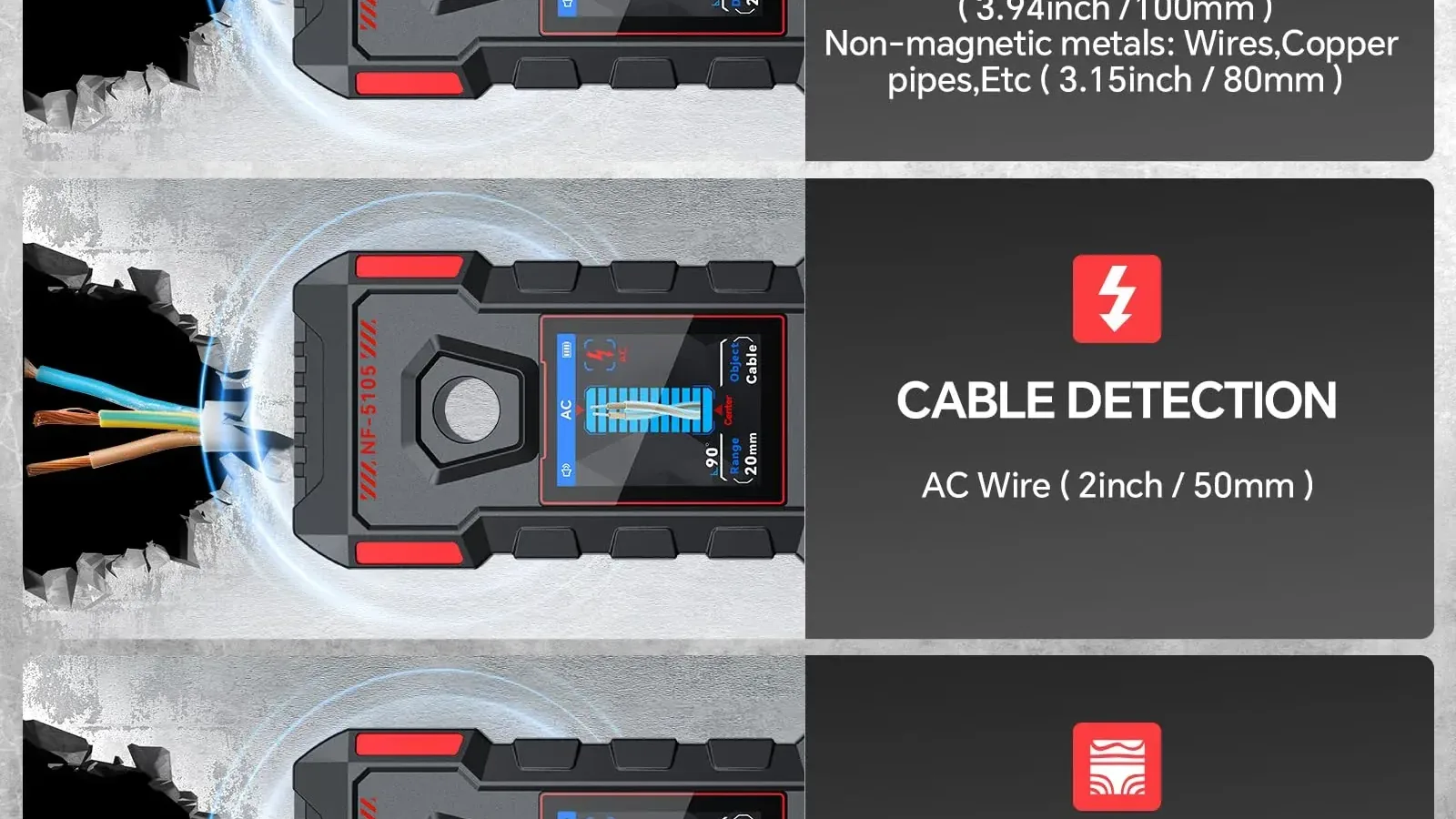
Some tiled installations also include metal trims, mesh reinforcement, foil-faced material or conductive finishes. Moisture may be present around showers, baths, basins and poorly ventilated areas. Manufacturer guidance for detector categories warns that conductive wall surfaces, including certain tiles, may prevent a possible cable from being indicated or may produce a broad warning area. Damp walls and metallic foil can also impair live-wire indications.
Surface factors and the cautious response
| Tile-area factor | Why it matters | Cautious response |
|---|---|---|
| Tile thickness and density | The detector is reading through more than a simple painted finish. | Expect more uncertainty and avoid relying on one pass. |
| Adhesive and grout | Uneven coverage creates changing wall build-up. | Scan nearby points and look for a repeatable pattern. |
| Backing board or plaster | The material behind the tile may differ from the wall elsewhere. | Identify the complete wall build-up before choosing a fixing. |
| Moisture | Damp conditions can impair or spread some indications. | Stop if the result becomes broad or unstable. |
| Metal foil, mesh or trims | Metal layers and edges can mask or confuse responses. | Treat a metal indication as unresolved until checked another way. |
| Conductive finish | Some tile surfaces can affect possible live-wire indications. | Never read a missing indication as proof that the area is clear. |
What the scanner might be reacting to
A response on tile may relate to the object you care about, but it may also relate to something else. A metal response could be a pipe, conduit, screw, tile trim, metal stud, mesh, reinforcement or old fixing. A non-metallic change could relate to timber, a plastic pipe, adhesive coverage, backing-board joints or a void. A possible live-wire indication depends on the signal reaching the detector and can be affected by the surrounding materials.
The useful question is not simply whether the scanner sounded. Ask whether the result repeats, whether it follows a plausible route, whether it agrees with visible fittings, and what the consequence would be if the interpretation were wrong. Bathrooms and kitchens deserve a low tolerance for uncertainty because water and electrical services may be close to the proposed fixing area.
Visible clues still matter
Before scanning, note every socket, switch, light, shaver point, extractor, appliance connection and control nearby. Note taps, shower valves, radiators, boiler routes, waste pipes and visible pipe entries. These features do not provide a complete service map, but they help identify locations where a surprising detector result should be treated seriously.
Electrical Safety First warns about accidentally drilling, nailing or screwing into hidden wall cables. It advises locating cables before work, switching off power for DIY close to electrics and asking a registered competent electrician when uncertain. Approved Document P provides the England domestic electrical-safety framework. Neither source turns a wall scanner into an electrical tester or professional approval.
A cautious tiled-wall workflow
First identify the job and the likely wall construction. Tile over solid masonry presents a different fixing and scan problem from tile over plasterboard, backer board or a framed partition. If the wall build-up is unknown, make that uncertainty part of the decision rather than assuming the surface continues uniformly.
Scan the proposed area and a wider margin around it. Move the detector as its instructions require. Repeat passes from different directions and mark warnings or uncertain zones rather than marking safe holes. If the result appears over every tile, changes category, spreads over a broad area or disappears on repeat passes, treat it as unresolved.
Unresolved should usually mean moving the fixing, using a suitable non-drilling option when the mounted product and surface permit it, investigating from an accessible opposite side, or asking the appropriate competent trade to inspect. It should not mean trying a test hole.
Quick buying and pre-drilling checklist
- Choose a scanner category for the object and wall type you need to investigate, not simply because the packaging mentions walls.
- Read the tool's limitations for tiled, damp, conductive or foil-backed surfaces.
- Do not assume it can see through tile, adhesive and backing as one transparent layer.
- Map visible electrical and plumbing clues before scanning.
- Look for repeated, plausible patterns rather than one indication.
- Mark danger and uncertainty areas, not safe drill points.
- Do not drill on the basis of a negative scan.
- Use a competent professional for bathroom, kitchen or electrical uncertainty.
When a reading is too ambiguous to use
A reading is too ambiguous when it appears across a broad part of the tiled surface, disappears when scanned in another direction, changes between categories, or sits near a route that could contain a cable or pipe. The same applies when the wall is damp, recently repaired, unusually thick, foil-backed or known to contain mesh or metal trim.
Ambiguity is a result in its own right. If a tool cannot produce a stable and plausible pattern, the conservative decision is not to drill there. The cost of repositioning an accessory or arranging an inspection is usually far lower than repairing a damaged cable, pipe, waterproofing system or tile finish.
The backing wall still controls the job
Tile over masonry can conceal cables chased into the wall, pipes, metal fixings and old repairs. Tile over dot-and-dab board can hide voids, adhesive dabs and services between board and masonry. Tile over a framed partition can hide timber or metal studs, noggins, pipes and cables in the cavity.
Do not assume a hard surface means a clear wall. Do not assume a hollow sound proves that timber studs are present. Do not assume a metal signal identifies a pipe. Wall construction helps you interpret clues, but it does not remove the need for service awareness and professional help where the result matters.
Related guides
For broader detector selection, read the best stud finder UK guide. If hidden electrical cable is the main concern, use the guide to finding wires before drilling. The magnetic stud finder guide explains why a magnet has a different and narrower role.
FAQ
Can a scanner definitely detect pipes behind bathroom tiles?
No. A response may suggest metal or another concealed object, but it is not a pipe map. Pipes may be plastic or metal and may sit among other materials that affect the reading.
Can a wall scanner find live wires through tiles?
It may indicate possible live wiring under some conditions, but conductive tiles, damp walls, metallic foil and other factors can impair or broaden the indication. A missing indication is not proof that no cable exists.
Is it safe to drill if the scanner shows nothing?
No. A negative scan is not proof of a clear drill path. Combine scanning with wall construction, visible clues and professional advice when the area is close to services or the build-up is unknown.
Can tile adhesive affect readings?
The changing thickness, coverage and voids in an adhesive bed add another layer for the detector to interpret. This can make the pattern less stable, especially when combined with moisture, mesh, foil or conductive finishes.
Should I scan only the planned hole?
No. Scan a wider area so that lines and repeated patterns have context. A single point provides too little information to distinguish a concealed route from a local fixing or surface feature.
Final buying advice
For tiled walls, use a cautious and conditional buying mindset. A scanner can help gather clues, but it cannot promise through-tile detection, identify every hidden service or prove that a hole is safe. You can review a multi-mode wall detector as one option, then judge it alongside the surface, wall build-up, nearby services and the consequence of uncertainty.
Sources and further reading
- bosch-professional.com: Detector-category limitations for conductive tiles, damp walls, metallic foil, earthing and object ambiguity.
- electricalsafetyfirst.org.uk: UK DIY guidance for cable location, power-off near electrics and competent-electrician escalation.
- gov.uk: England domestic electrical-safety framework.